
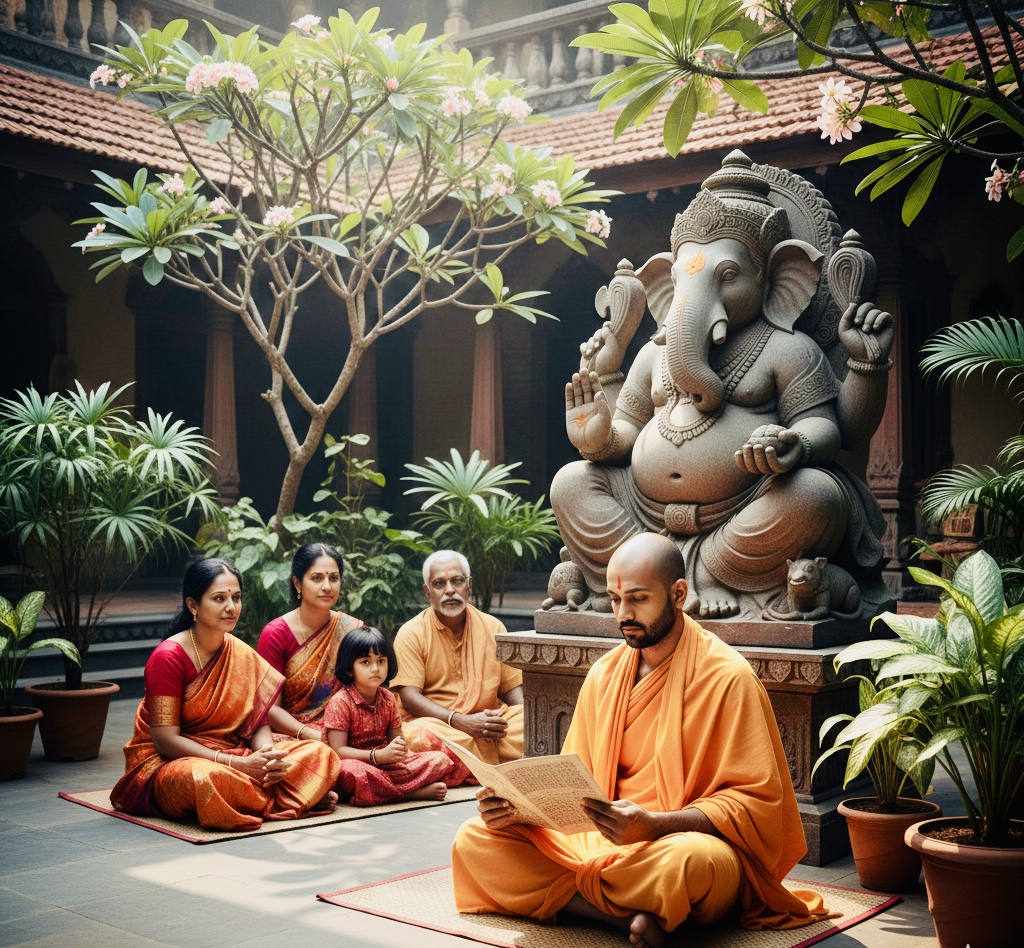
May We Hear All That Is Auspicious?
Most seekers think spiritual growth means adding more practices, more mantras, more austerities as if the Divine keeps score on how complicated our spiritual checklist becomes.
But the old sages whispered a different truth:
Spiritual greatness is not measured by how complex our practice becomes, but by how open our heart remains.
And sometimes… the simplest doorway is listening.
The Mantra
ॐ भद्रं कर्णेभिः शृणुयाम देवाः।
भद्रं पश्येमाक्षभिर्यजत्राः।
स्थिरैरङ्गैस्तुष्टुवाग्ँ सस्तनूभिः।
व्यशेम देवहितं यदायुः॥
ōṁ bha̲draṁ karṇḗbhiḥ śr̥ṇu̲yāmá dēvāḥ |
bha̲draṁ páśyēmā̲kṣabhi̲ryajátrāḥ |
sthi̲rairaṅgaìstuṣṭu̲vāgṁ sásta̲nūbhíḥ |
vyaśḗma dē̲vahíta̲ṁ yadāyúḥ |
May we hear what is auspicious with the ears.
May we see what is auspicious with the eyes.
With steady limbs and hearts full of praise,
May we live a life pleasing to the Divine.
This Śānti Mantra, found in the Prashna and Mandukya Upanishads, is often chanted before sacred recitations especially the Ganapati Atharvashirsha, beloved by Ganesha sadhakas.
Beautiful words but how do we actually live them?
What Does It Mean to “Hear What Is Auspicious”?
Great teachers from institutions like Chinmaya Mission and Ramakrishna Math have offered profound commentaries equanimity, mindful listening, dropping bias all beautiful, all true.
But what about the rest of us?
The parent doing school runs.
The employee answering emails.
The householder juggling bills, family, and maybe a little sadhana squeezed in at sunrise or bedtime.
How do we practice this?
The First Form of Bhakti: Śravaṇa
In the Bhāgavatam, Bhakta Prahlada describes nine forms of Bhakti and the very first is:
Śravaṇa: Listening.
Listening to the sacred stories:
Shiva drinking Halahala,
Krishna lifting Govardhan,
Murugan defeating Tarakasura.
Listening to the names one by one until each Nama becomes a doorway into His qualities.
This isn’t entertainment.
It’s alchemy.
Śuka Rishi declares:
“One who fills the ears with the nectar of the Lord’s stories becomes purified no matter how worldly their tendencies and attains the Lord.”
That is the power of hearing what is auspicious.
It softens the mind.
It strengthens faith.
It pulls the heart toward sadhana gently, quietly, irresistibly.
For Those Living a Non-Monastic Life
Not everyone is meant to sit in caves or under banyan trees.
Some are meant to raise families, sign contracts, cook meals, pay taxes and yet walk toward the Divine.
For them, Brahma himself gives reassurance:
“Those who stay in their homes and listen to the sacred narratives, surrendering mind and body to the Lord even they conquer Him, who is unconquerable by the three worlds.”
So yes, even on the way to work, during chores, between responsibilities we can live this mantra.
Swap gossip for kirtan.
Swap mindless scrolling for a discourse on the Mahabharata.
Swap noise for remembrance.
Not perfection just intention.
There Is Always a Way
In a world full of language, only a fraction is nourishing. But each time you choose a sloka over complaint, a bhajan over distraction, a story of the divine over the noise of the world…
You are practicing the mantra:
“May we hear what is auspicious.”
And slowly, without fanfare, the mind becomes sacred space.
If this resonated softly within you, you’re already on the path. Walk with us https://shorturl.at/4Fs5a into a Tantra community where practice becomes embodied and every step is held by grace.
No responses yet