
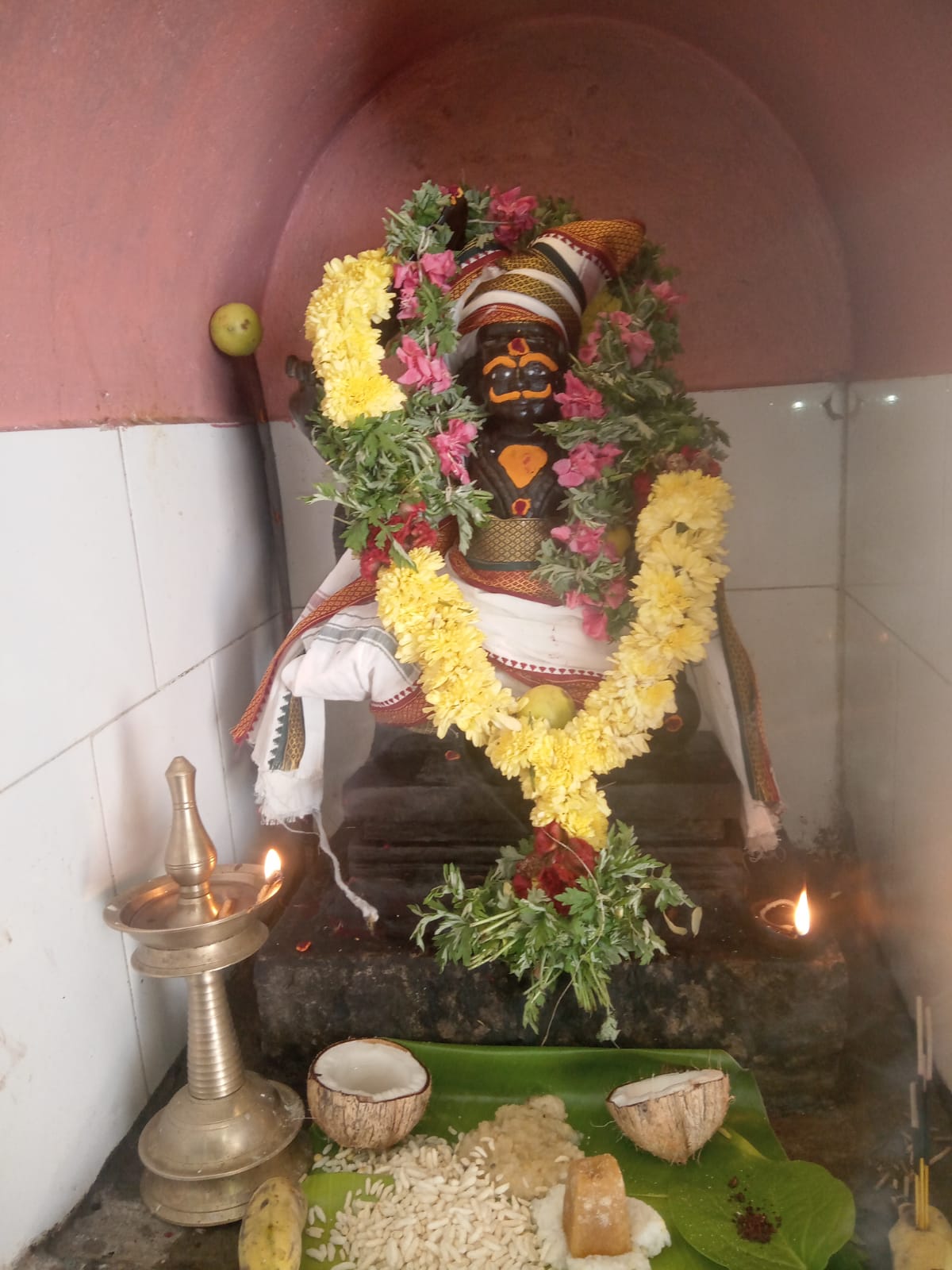
Every tradition has its self-appointed gatekeepers.
In today’s digital age, they arrive armed with hashtags, half-digested scripture, and a confidence wildly disproportionate to their understanding. The ancient Indian metaphor for this is beautifully precise: the frog in the well convinced that the sliver of sky it sees must surely be the whole universe.
One such myth these modern custodians of “exclusive Dharma” love to repeat is this:
“Only Tamils should worship Karuppan, because he is a Tamil god.”
It sounds authoritative.
It is also spectacularly uninformed.
Yes, Karuppan: Sangili Karuppan, Karuppasamy, Karuppar is deeply loved and widely worshipped in Tamil Nadu. But popularity is not the same as origin.
Historically, Karuppan’s roots within Bharata trace strongly into Kerala, from where his worship and guardianship traditions spread organically across regions.
This isn’t marketing. This is how living Dharma moves through people, practice, and protection.
Calling Karuppan worship “new” is rather like calling the banyan tree a recent invention because you only noticed its shade yesterday.
For generations, Karuppan has been invoked as a Kṣetrapāla, a guardian of boundaries; both physical and subtle. And his reach has never been limited by modern linguistic borders.
Long before social media debates, Karuppan crossed oceans with devotees. Today, his shrines stand not just in South India, but in Singapore, Malaysia, Canada, South Africa, and even the Caribbean, wherever the Tamil and Malayali diaspora carried their deities; not as cultural souvenirs, but as living protectors.
Interestingly, when one examines the timelines of these loud critics, a pattern emerges. Many are not neutral scholars at all, but enthusiastic promoters of their own sampradāya devatas. In some troubling cases, they even glorify entities that bear little resemblance to Dharmic guardians; forces closer to disruptive spirits than protectors.
This is the exact antithesis of Karuppan, who is revered as a hunter and remover of duṣṭa bhūtas and piśāchas, not their patron.
Sanatana Dharma has never worked on “regional ownership.”
A Devata is not a brand franchise. If protection, grace, and order are offered, devotion naturally follows across language, land, and lineage.
Karuppan does not ask where you are from.
He asks whether you stand in alignment.
And perhaps that is what unsettles the gatekeepers most.
If reflections like this help clear confusion and deepen understanding, you may find that such clarity grows best in shared spaces of sincere practice.
Our Tantra circle: https://shorturl.at/6gxgH explores Karuppan, Bhairava, and Gram Devata traditions not as trends, but as lived realities: grounded, protective, and uncompromising in their Dharma.
Karuppan Thunai.
No responses yet