
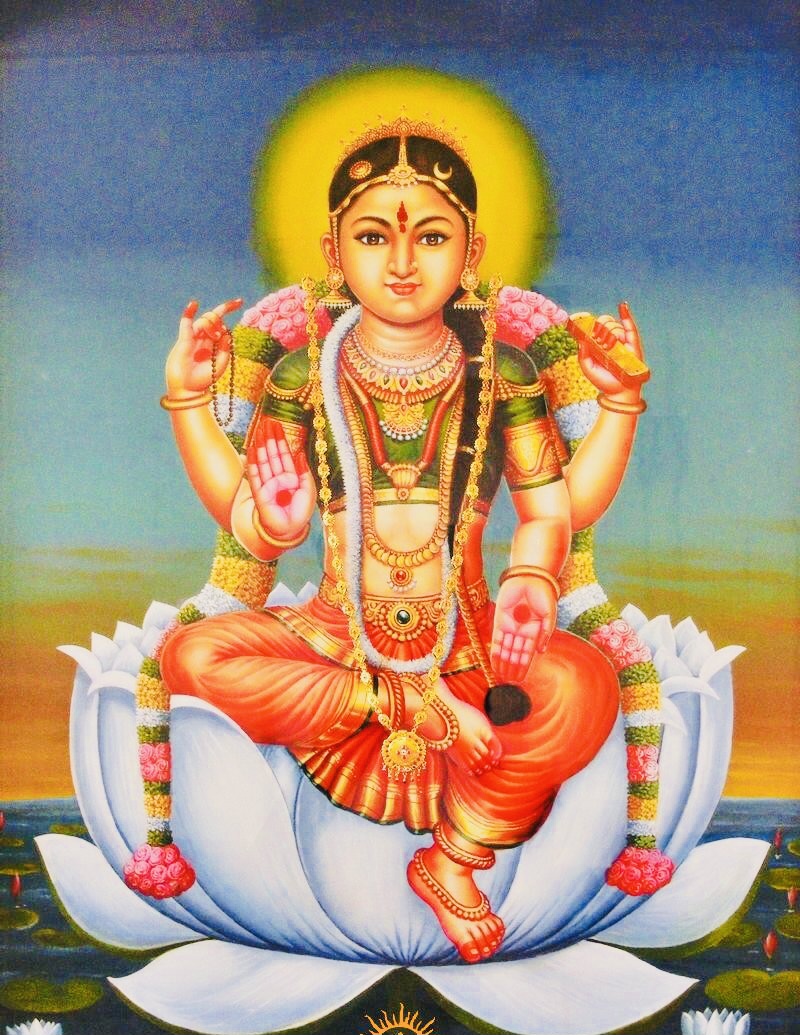
If the Goddess had a heartbeat, it would sound like laughter.
mukhē śrī mātaṅgī tadanu kila tārā ca nayanē
tadantaṅgā kālī bhr̥kuṭisadanē bhairavi parā |
kaṭau chinnā dhūmāvatī jaya kucē śrīkamalajā
padāṁśē brahmāstrā jayati kila bālā daśamayī
Meru Tantra has a luminous hymn called the Daśavidyāmayī Bala Stotra. It tells us something quietly radical: the ten great Mahāvidyās are not separate powers competing for spiritual attention.
They are emanations of Bala Parameshwari herself.
Her face is Śrī Mātaṅgī, her eyes are Tārā, her brow is Bhairavī, her waist is Dhūmāvatī, and her feet rest as Śrī Kamalā. In other words, the vast and fearsome spectrum of divine wisdom is housed inside a very gentle form.
In the Lalitā Mahā Tripura Sundarī katha, Bala is described as the heart of Lalitā Devi. Not a poetic flourish, but a metaphysical clue. In my own limited experience, she feels like the heart of all Devis, all Śakti Pīṭhas, and all Mahāvidyās.
Which raises a simple question: what do we mean by “heart”?
Bala is Sthūla Śakti ; the most tangible, perceivable expression of the Goddess. She is the first presence you feel when you step into a Śakti kṣetra.
Before visions, before philosophies, before cosmic fireworks, there is Bala.
Grace you can sense. Compassion you can relax into.
This is why she is so beloved by beginners.
She doesn’t test your metaphysics. She takes your hand.
The paradox is beautiful. The Goddess in her subtlest, formless state chooses to appear as a young girl , a Kumari playing in the very material world we often feel trapped in.
She meets us where we are, and only then, if we wish, leads us inward.
Nowhere is this more visible than at Kamakhya. At one level, she is the Yoni Pīṭha ; the womb of all existence. At another, she runs around as laughing kumaris, teasing sadhakas who take themselves a bit too seriously.
A friend once told me of a stern Aghori there, suddenly found laughing and playing with the young girls like a child himself. Even Guruji Sri Amritananda Saraswati is said to have experienced Kamakhya primarily as Balambika.
Once, after a purascharana, I sat for japa at a local Devi temple, hoping rather politely for a sign. As my eyes closed, the air shifted. I heard giggling. I opened my eyes and saw a little girl in red, silver anklets flashing as she hopped around the temple, playfully disrupting the solemn mood.
Her mother arrived: regal, also clad in red, face unseen. The child ran to her, held her arm, and they walked away together. Same. Yet different.
Later that day, a parcel arrived from a senior upāsaka.
Inside was a smiling murti of Bala Kumari herself.
She is the worshipped.
She is the worshipper.
For a beginner, what gentler truth could there be?
If something in this story stirred recognition rather than simple curiosity, perhaps the Divine is already whispering to you in a language older than thought.
You’re welcome to step into our Tantra circle https://shorturl.at/4Fs5a a quiet, living space where beginners are guided learning to trust the presence that meets us first in simplicity before opening into infinity.
Shri Kamarupinyai Namaha
Joy Ma
No responses yet