
In the sacred traditions of Hindu Dharma, honouring our ancestors; the Pitrus ; is considered a profound act of gratitude.
Rituals such as Shraddha and Tarpana are not merely cultural practices; they are spiritual bridges connecting generations.
Yet there is a subtle and powerful truth behind these rituals that many seekers overlook.
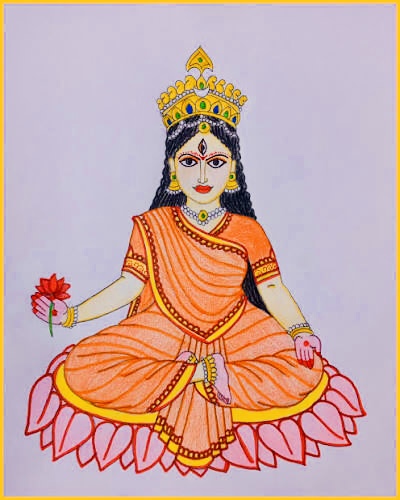
Just as offerings in a homa reach the Devas, only through the grace of Swadha Devi, the offerings made to the ancestors reach the Pitrus.
Without her, the offerings of Pitru Karya do not reach their intended recipients.
Her sacred presence is beautifully acknowledged in the powerful Argala Stotram, where the Divine Mother is praised through many names:
Om Jayanti Mangala Kali Bhadrakali Kapalini
Durga Kshama Shiva Dhatri Swaha Swadha Namostute
Meaning:
“O Goddess Jayanti (the victorious one), Mangala (the auspicious giver of liberation), Kali, Bhadrakali, Kapalini, Durga, Kshama (the embodiment of patience), Shiva, Dhatri, Swaha and Swadha: salutations to You.”
Even the mighty Arjuna praises the Divine Mother in the Mahabharata:
Swahakarah Swadha chaiva Kala Kastha Saraswati
Savitri Vedamata cha tatha Vedantaratmana
Meaning:
“You are the sacred sound of Swaha and Swadha, the nourishment of the ancestors.
You are Time itself, Saraswati, Savitri the Mother of the Vedas, and the inner soul of the Vedas.”
Below is the sacred Swadha Stotram, revealed by Brahma in the Brahma Vaivarta Purana.
Swadha Stotram – Sri Brahma Uvaacha
1.
Swadhoh.chaarana maatreyynuh theerthasnaayii bhaven narahuh ।
muchyate sarvapaapebhyoh vaaja-peya phalam labhettt ॥
Meaning: By uttering the word Swadha, a person becomes purified as though bathing in sacred tirthas and gains the merit of the Vajapeya Yajna.
2.
Swadhaa swadhaa swadhettt yehhhvam yuh-di vaaruh trayam smaret ।
shraadhasya phalamaapnohhti kaalasya tarpanasya cha ॥
Meaning: One who remembers Swadha, Swadha, Swadha three times gains the fruits of Shraddha and Tarpana.
3.
shraadha-kaaley swadhaa stotram yahushhra-nohhti samaa hitahuh ।
labhet shraadha-shataa-naam cha punyamevuh na sanchayahuh ॥
Meaning: One who listens to this hymn on the day of Shraddha receives the merit of performing a hundred Shraddhas.
4.
swadhaa swadhaa swadhettt yehhvam trisandhyam yahapathen narahuh ।
priyaam viniitaam salabhettt saadhviim putram gunaanvitam ॥
Meaning: Reciting the sacred name Swadha during the three Sandhyas brings blessings of a virtuous spouse and noble children.
5.
pitrunaam praanatulyaa tvam dwiijuh jiivana roopinii ।
shraadhaa dhishthaatru devii cha shraadhaa diinaam phalapradaa ॥
Meaning: O Goddess, you are the very life of the Pitrus and the presiding deity of Shraddha, granting its fruits.
6.
bahir gachcha manmanasahuh pitrunaam tushti heyy-tuhve ।
sampriitaye dwijaa tiinaam gruhinaam vrudhi heyy-tuhve ॥
Meaning: May you manifest for the satisfaction of the ancestors, the joy of the Brahmins, and the prosperity of householders.
7.
nityaa tvam nitya swarupaasi gunarupaasi suuvratey ।
aavir bhaavasti rohhbhaavuh srushtou cha pralayehh tavuh ॥
Meaning: You are eternal, virtuous, and present both in creation and dissolution.
8.
om swastishcha namahas swaahaa swadhaa tvam dakshinaa tathaa ।
niruuupitaas chaturvedey shat prashastaash cha karminaam ॥
Meaning: You are Om, Namah, Swasti, Swaha, Swadha, and Dakshina; forms praised in the four Vedas.
9.
puraa-siis tvam swadhaa gopii gohhlohhkey raadhikahh sakhii ।
dhrutohh-rasi swadhaat maanam krutam teyynuh swadhaa smrutaa ॥
Meaning: In Goloka you were once a Gopi named Swadha, a companion of Radha, honoured by Lord Krishna.
10.
etyehhtva muktvaa suh bramhaa bramhalohhkey cha sansadi ।
tasthou cha sahasaa sadyahuh swadhaa saavir babhoova huh ॥
Meaning: After Brahma praised her, Goddess Swadha appeared before him.
11.
tadaa pitruubhyaha pradadou taameyyva kamala nanaam ।
taam sampraapya yayuste cha pitarashcha praharshitaa ha ॥
Meaning: Brahma offered her to the Pitrus, who rejoiced upon receiving her.
12.
swadhaa stotra-midam punyam yahushra-nohhti samaa hitahuh ।
suhs-naatahuh sarva tiirtheyyyshu vedapaatha phalam labhetttt ॥
Meaning: One who listens to this sacred hymn gains the merit of bathing in all holy places and the fruits of Vedic recitation.
In this way, the Swadha Stotram, composed by Brahma in the Prakriti Khanda of the Brahma Vaivarta Purana, glorifies Swadha Devi.
In simple terms, the message is clear; when Swadha Devi is remembered, the connection between the living and their ancestors becomes alive and meaningful.
And perhaps that is one of the quiet beauties of this tradition: even a single sacred word Swadha can become a bridge between generations.
If teachings like these help you see Mantra, Tantra, and ancestral traditions in a deeper light, you may enjoy exploring further with fellow seekers. Our Tantra circle gently explores such sacred knowledge and practices together and you’re warmly invited to step into the space: https://shorturl.at/6gxgH whenever you feel called.
No responses yet