
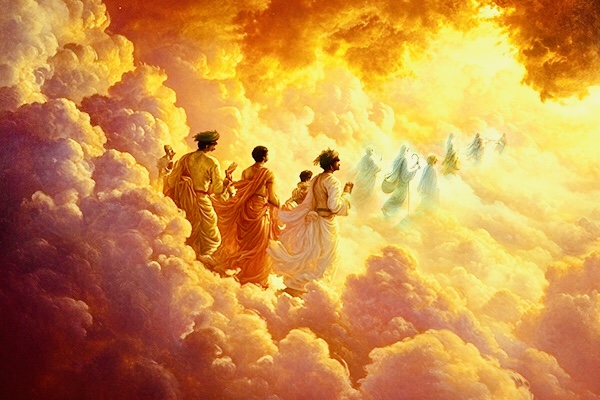
Amavasya is a sacred time set aside for the worship of the Pitrus.
The Pitrus are not merely our immediate ancestors. They are a group of divine beings connected to the Devas. It is said that when we worship our forefathers with sincerity, the offering ultimately reaches the Pitru Devatas themselves.
Scriptures speak of seven classes of devāḥ pitaraḥ; the divine Pitrus. Three among them are amurtayah (incorporeal): Vairajas, Agnishvattas, and Barhishadas. The remaining four are samurtayah (corporeal): Somapas, Havishmanas, Ajyapas, and Sukalins (also called Manasas).
This is not symbolic poetry.
It is a reminder that lineage in Sanatana Dharma is both earthly and celestial.
In certain versions of the Mahabharata, when Bhishma and Parashurama were locked in fierce combat and stood evenly matched, it was the Pitrus who revealed to Bhishma the subtle knowledge required to overcome the legendary Parashurama. Even the greatest warriors receive strength from their lineage.
When Amavasya coincides with Somavara and an eclipse, its significance deepens further. Such a day is especially powerful for Pitru worship.
Taking a dip in holy rivers, offering prayers, and feeding crows, cows, and dogs in the name of the Pitrus are all recommended. A simple chant such as:
“Aum Pitru Devatabhyo Namaha”
can be offered with devotion.
Here is a Puranic Pitru Stotra that may be chanted by all:
Om nama pithre, janma dhāthre, sarva deva mayāya cha, sukhadhāya prasannāya supreethāya mahāthmane.
Sarva yajna swaroopāya, swarkāya parameshtine,
sarva theerthavalokāya, karunā sāgarāya cha.
Nama sadā āsuthoshāya, siva roopāya tey namaha,
sadā aparā dhakshamine, sukāya sukhadhāya cha.
Durlabham mānushamidham yena labhdham mayā vapuhu, sambhāvaneeyam dharmārthey, thasmai pithre namo namaha.
Theerthas snāna thapo homa japādhi yasya darsanam, mahā gurescha gurave thasmai pithre namo namaha.
Yasya pranāma stavanāth kohtisup pithru tharpanam,
Aswamedha sathai sthulyam, thasmai pithre namo namaha.
It reminds us that human birth is rare, that through our ancestors we have received this body, and that honouring them is equal to performing great yajnas.
The Stotra praises the Pitrus as embodiments of yajna, as compassionate beings, easily pleased, forgiving of faults, and as oceans of mercy.
It declares that devotion offered to the Pitrus, even by those who have faltered in Dharma, brings their grace and honour. It equates sincere remembrance with the merit of performing one hundred Ashwamedha yajnas.
Such is the greatness of Pitru worship.
Amavasya, therefore, is not a night of emptiness. It is a night of remembrance; a time to bow in gratitude to those through whom this rare human birth has come.
And when remembrance becomes part of our spiritual rhythm, whether through Mantra, prayer, or deeper Tantra practice, our path gains unseen support.
If reflections like these speak to your heart, you may wish to walk further with us in our Tantra circle: https://shorturl.at/6gxgH where devotion ripens into lived experience, and every step is taken with reverence for lineage and grace.
No responses yet