
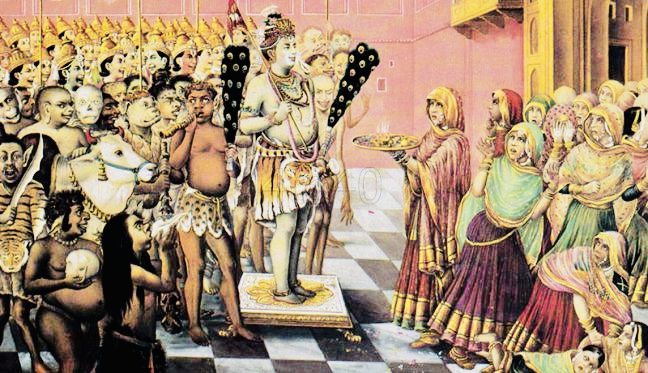
There’s an old saying that quietly appears across both Western occult traditions and the South Indian Siddha lineage:
“As above, so below.”
At first glance, it sounds poetic the kind of line we nod at and move on. But sit with it a little longer, and it begins to unfold.
Yes, it means that whatever exists in the vast universe also exists within us. The body becomes a map of the cosmos. The inner mirrors the outer.
But there’s another layer one that becomes especially important in Mantra and Tantra practice.
The structure of existence itself particularly hierarchy is reflected across all realms.
Look around in the simplest ways.
A colony of ants functions with order. Bees have roles. Even modern systems governments, corporations, armies operate through hierarchy. Not because humans love control (well… sometimes we do), but because order naturally organizes itself this way.
Now imagine this principle not just on Earth… but in subtler realms.
In Hindu Dharma, the Divine is not a flat concept. It is layered, structured, alive.
There is a Hierarchy of Beings.
At the closest level to human life, you have:
• Grama Devatas: guardians of the land and community
• Kula Devatas: protectors of lineage and family
These are not abstract deities concerned with lofty liberation alone. They are deeply involved in life as it is lived:
• Crops growing well (or not)
• Health, disease, recovery
• Continuity of the family line
They are, in a sense, the first responders of the spiritual ecosystem.
And here’s something subtle; these Devatas were often invoked and established by Rishis and Siddhas, not as distant cosmic forces, but as accessible presences tailored to the needs of a community.
As one moves deeper into Tantra Sadhana, the structure becomes more intricate.
Between the devotee and the Moola Devata, there exist layers:
• Kshetrapalas (guardians of sacred space)
• Avarana Devatas (energies surrounding the core deity)
• Ganas and Parivaras (attendant forces who execute functions)
Take Ganesha.
In popular understanding, he is the remover of obstacles. Simple enough.
But in Ganesha Mantra Tantra, he is surrounded by countless Ganas; forces that themselves embody, regulate, and sometimes even create obstacles.
These Ganas are not random.
They are organized, often under commanders like Sumukha, Aamoda, and Pramoda.
Which means:
When you approach Ganesha deeply, you are not approaching an individual… but an entire field of intelligence.
This is why certain traditions include:
• Tarpanam (offerings of appeasement)
• Bali (symbolic offerings, even as simple as Kushmanda)
Because ignoring the supporting forces while invoking the central deity is like trying to speak to a king while disregarding his entire court. It… rarely goes smoothly.
Similarly, Murugan is not just a youthful warrior deity.
He is the commander of Deva forces, served by the Nava Veeras: powerful archetypal warriors such as Veera Kesari and Veera Mahendra, each representing specific aspects of shakti and courage. Their role is not symbolic alone; they are part of the functional hierarchy that operates in his domain.
Or consider Ayyappa.
His path, especially in the Sabarimala tradition, is said to be guarded by fierce Bhuta Ganas led by chieftains like Karuppan Swami and others. Devotees often believe that during the vrata, these forces actively protect not just the individual… but their entire household.
Pause and reflect on that.
A single devotee… supported by an entire unseen network.
Even Kamadeva, often seen lightly as the god of desire, is described as being served by the Maras; yet another structured layer of forces.
And this principle is not limited to divine realms alone. Even in descriptions of lower or nether realms, both in Hindu and Western occult traditions, beings are said to operate in legions, with defined ranks and roles.
What This Means for You as a Seeker
Here is where this becomes deeply personal.
Most beginners in Mantra and Tantra approach spirituality with a simple mindset:
“I will choose one Devata… and that is enough.”
It’s a beautiful beginning. But not the complete picture.
Because in Tantra:
You are not just building a relationship with a deity.
You are entering a living system of relationships.
And like any system:
• Respect matters
• Alignment matters
• Awareness matters
When you honour:
• Your Kula Devata
• Your Grama Devata
• The Ganas, Kshetrapalas, and Avarana Devatas
You are not complicating your path.
You are harmonizing with the structure that already exists.
Ignore it… and obstacles appear that feel mysterious, unnecessary, even frustrating.
Work with it… and something quietly shifts.
Your Mantra begins to feel alive.
Your Tantra practice gains depth.
And instead of pushing through resistance, you begin to feel… supported.
Almost as if the path recognizes you.
If this deeper layer of Tantra resonated with you, not just intellectually, but somewhere more intuitive then you may be ready to move beyond scattered understanding into lived experience.
Step into our Tantra circle: https://shorturl.at/6gxgH, where these sacred hierarchies are not just concepts, but gently explored through guided practice and devotion.
No responses yet