
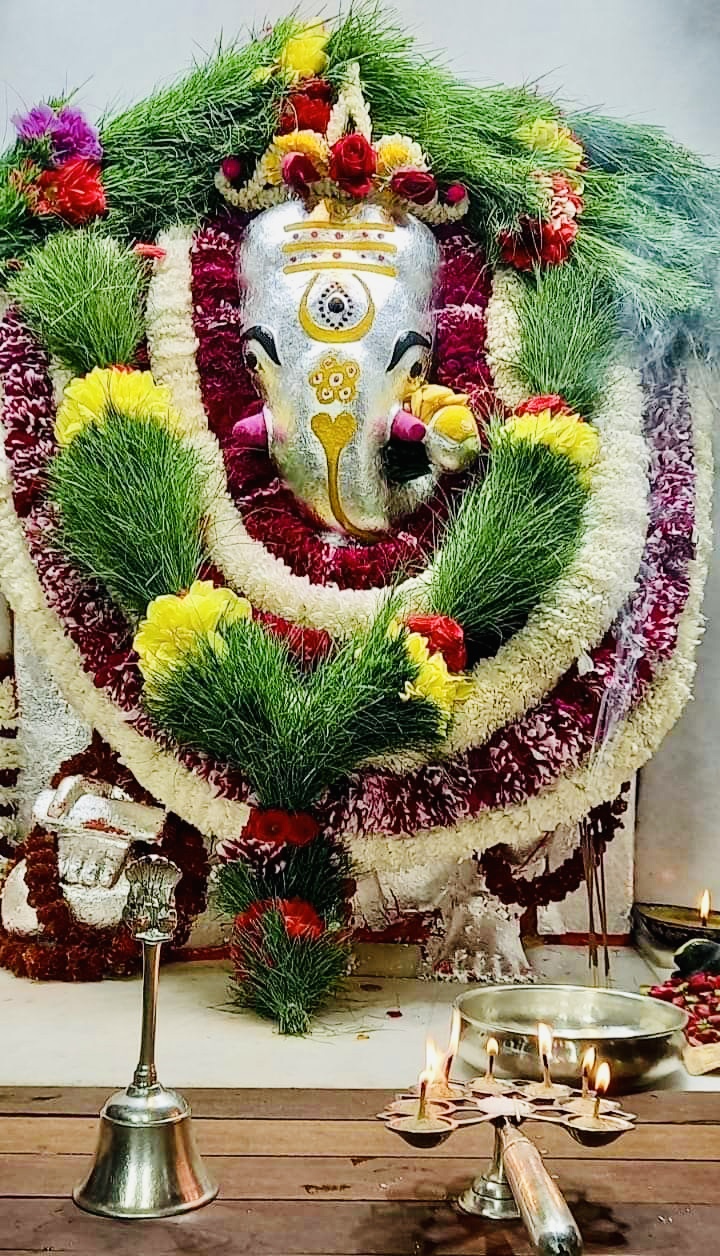
In the gentle grammar of Hindu ritual, nothing is ever random. Every flower, every leaf, every offering carries a story and a secret.
Among all the sacred items offered to Lord Ganesha, Durva grass (Arugampul) holds a place that is both humble and extraordinary. Along with red hibiscus, rakta chandan, and sindur, Durva is not an optional embellishment.
It is the quiet essential.
Why grass, of all things?
One Purāṇic story gives us a clue. Durva was once a radiant being, a creation of Brahma himself, blessed with beauty, prosperity, and abundance. But as often happens, grace without humility curdled into pride. Durva repeatedly insulted Maa Parvati until one public slight crossed the line.
Parvati Devi, patient but firm, cursed her: “May you become grass-like.”
Shattered, Durva turned to Sri Ganesha with sincere tapasya and bhakti. Ganesha, ever the compassionate son, upheld his mother’s words yet transformed the curse into a blessing. “Even as grass,” he said, “you will be dear to me. My puja will never be complete without you.” And so Durva, once proud, became indispensable.
Another story reveals Durva’s cooling grace. When the fearsome Analāsura was swallowed by Ganesha in his bāla rūpa, the asura’s inner fire caused unbearable heat. The Devas tried everything: sandalwood paste from Parvati, rain from Varuna, moonlight from Chandra (giving rise to the name Bhalachandra), even Vishnu’s lotus (Padmapāṇi). Nothing worked.
Only when Sage Kashyapa and other rishis offered Durva grass from their homa rituals did the fire subside instantly. From that moment, Ganesha declared Durva eternally dear to him.
There’s also the quietly humorous tale from King Janaka’s court. When Ganesha appeared as a Brahmin guest, he ate so much that the royal kitchens were emptied. Yet two simple blades of Durva, offered with devotion by Sage Trishira, satisfied him completely.
Quantity bowed to quality. Ego bowed to bhakti.
Perhaps the most striking story is of Rishi Kaundilya and his wife Ashraya, who doubted Durva’s greatness. When a single blade was weighed against the combined gold of Indra, Kubera, the Devas; even the Trimurtis; it outweighed them all.
Grace, it seems, has its own mathematics.
On this Mahotkata Jayanthi, as we worship the remover of obstacles, Durva reminds us of a deeper truth: humility cools the fiercest fires, and the smallest offering when soaked in devotion can outweigh the riches of the three worlds.
If these reflections stirred something within you, perhaps it’s time to step beyond reading and into practice into a living tantra circle: https://shorturl.at/6gxgH where devotion becomes experience, and Ganesha’s grace is not just discussed, but felt.
(Thanks to Yogindra Peeth Morgoan and Mallika Ji for the translation)
Shri Maha Ganapataye Namaha
Sangili Karuppan Thunai
No responses yet