
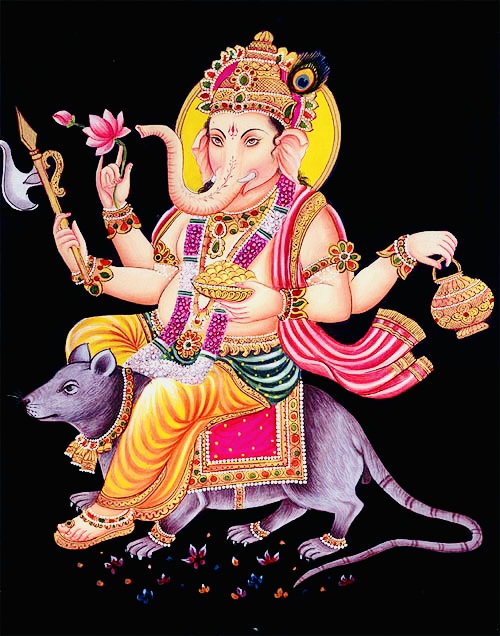
Every origin story hides a lesson. Some whisper it gently. Others arrive wearing an elephant’s face and a broken tusk.
This lesser-known account of Gajamukhasura helps explain why the Ganesha Mantra is not merely a ritual prelude, but a tool for real inner transformation.
Long ago, under the guidance of Shukracharya, the Asura guru, the Asuras sought to strengthen their lineage.
Their plan was unusual: merge their bloodline with that of a powerful Rishi. They chose Maragadar, a sage immersed in fierce tapas deep in the forest.
To approach him, they sent Vibudha: an Asura woman whose beauty was said to surpass even the legendary Apsara Menaka.
But here is where the story quietly turns. Vibudha did not seduce. She sat beside the Rishi and entered tapas herself. Years passed. Her discipline burned so intensely that it disturbed even Maragadar’s meditation.
When he opened his eyes, the first sight before him was of two elephants absorbed in instinct. Desire stirred, and the steady discipline born of long tapas momentarily softened. As he turned, he beheld the radiant Vibudha, and the same current of attraction deepened.
Sensing the shift within him, Vibudha rose from her own tapas and bowed at the Rishi’s feet, expressing her wish to unite with him. Maragadar replied that it was not fitting for a Rishi to act upon such desire in that form.
Therefore, drawing upon his inner shakti, he transformed both himself and Vibudha into elephants, and in that form they united.
From their union emerged powerful beings, among them Gajamukhasura, an elephant-faced Asura. Through severe tapas to Shiva, he received a formidable boon:
He could not be killed by any deva, human, animal, or weapon, only by Shiva’s own Shakti.
Elsewhere in Kailash, Devi lingered in quiet wonder before a luminous vision: two elephants playfully moving through a flowing river. With gentle curiosity, she turned to Shiva and asked about its meaning.
Shiva then shared the unfolding account of Gajamukhasura and softly acknowledged that the moment had arrived to bring his growing excesses to rest.
From their combined Shakti emerged Ganesha, who was blessed as Ganapati, the leader of the Ganas and the gateway to all divine access. Hence the rule practitioners know well:
Without Ganesha, nothing moves forward.
The young Ganesha faced Gajamukhasura in battle. The Asura failed to recognize young Ganapati and mocked him, repeating his boon. Ganesha smiled not with arrogance, but clarity. “I am not man, deva, or animal. I am Shiva’s Shakti.”
He broke his own tusk and struck Gajmukhasura, not with a weapon, but with awareness.
Defeated, Gajamukhasura fell at Ganesha’s feet seeking forgiveness. Ganesha relented and did not destroy him. He transformed him saying since you asked for forgiveness and came to my feet, the darker tendencies that once ruled you have dissolved.
From now on, you will be my vahana, taking the form of a mouse. And in the same way, anyone who truly comes to me will find their negative habits and harmful patterns slowly losing their hold
Prabhu, yours is the rare compassion that blesses even an enemy, when judgment lay close at hand. Said Gajamukhasura filled with reverence to Ganesha and was transformed into Mushika (mouse), Ganesha’s vahana.
This is why Ganesha is the Deva to take refuge in when one seeks to curb habits, addictions, and self-sabotaging patterns.
Ganesha does not suppress the shadow. He redeems it.
If this story reframes how you see Ganesha, not just as a remover of obstacles, but as a transformer of inner compulsions; you may be ready to move from reading into practice.
Our Tantra circle https://shorturl.at/4Fs5a exists for seekers who wish to engage these teachings with sincerity, discipline, and grounded guidance step by step, without theatrics, but with lived depth.
No responses yet