
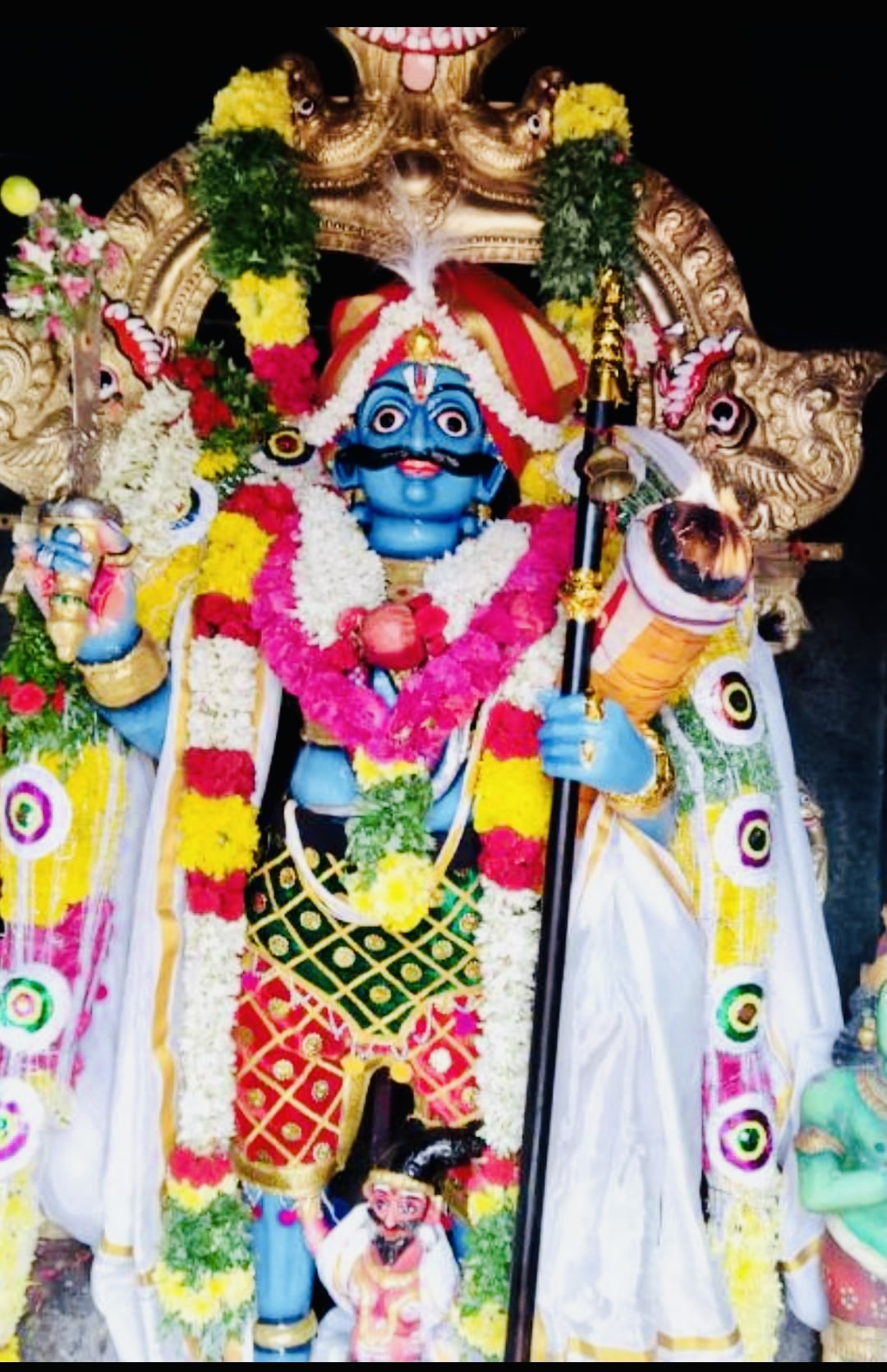
If you’ve ever wondered what a Devata really stands for, the Gayatri mantra and the Rishi of the Moola mantra are often quiet little truth bombs.
In the case of Karuppan, his Gayatri praises him as Kālakāla: the slayer of Time itself. And who sits comfortably on that throne?
None other than Mahākāla.
To make things more interesting, the Rishi of Karuppan’s Moola mantra is Mahākāla Bhairava.
Just like how Dakshinamurti being the Rishi for Bala Tripura Sundari reveals her inner essence as the Guru tattwa, this connection isn’t accidental, it’s the fingerprint of lineage.
Tamil folklore weaves another thread through this tapestry. In one story, when Surapadman takes over Indra Loka, Indrani flees to perform Shiva Puja in the forest. Surapadman’s sister, Ajamukhi, attacks and from that moment of danger emerges Mahākāla, the fierce Kṣetrapāla form of Rudra, severing her hands and restoring balance.
In village traditions, this protective Mahākāla aspect of Shiva becomes Karuppan, with Kāla carried forward through the Tamil word Karuppu.
Now, before anyone rushes to declare “Karuppan = Mahākāla Bhairava perfectly and exactly,” take a breath.
This is where emanations matter.
Grama Devatas are not lesser, they are specific, targeted expressions of vast cosmic forces. They’re like specialized medicine: precise, fast, and effective.
Ma Shitala Devi (Mariamman) and the regional goddesses of rain and healing descend from Parā Shakti as precise emanations; not for liberation, but for swift intervention. They exist to address specific human needs with a power that is immediate, intimate and unmistakable.
Mahā Ganapati is vast and all-encompassing, depicted with five pairs of hands, each pair symbolizing a distinct Devata aspect. Yet it is only the final pair, holding the Beejapura fruit and the broken tusk (Danta), that embodies Pushtipati Vinayaka, the beloved son of Shiva and Uma: Ganesha in his most familiar role as the remover of obstacles and fulfiller of prayers.
Similarly, Karuppan is the Mahākāla expression most accessible in the physical plane for protection, justice, and clearing imminent danger.
Ask any serious Bhairava Upasaka; the energies of Bhairava and Karuppan sit astonishingly close.
A Shakta practitioner once revealed an intriguing insight:
“For certain kinds of trouble prayogas, black magic sometimes even Mahā Varahi’s homas remain silent. But send the person to a Karuppan shrine near the smashan, and the darkness evaporates before you can ask how.”
Now, Mahā Varahi is no minor deity she is one of the Great Goddesses, the commander of Ma Lalitha’s army. But in the dense, physical plane, Karuppan’s energy is immediate, raw, and incredibly responsive especially for matters that demand swift resolution.
And if you ever visit the Mahākāla shrine in Kathmandu, where even Buddhists offer alcohol, you’ll feel the same unmistakable pulse of Karuppar.
If this exploration sparked recognition or curiosity, perhaps it’s time to deepen your connection. Step into our Tantra Sadhana community https://shorturl.at/4Fs5a a space where Karuppar isn’t theory, but living experience.
Sangili Karuppar Thunai
No responses yet