
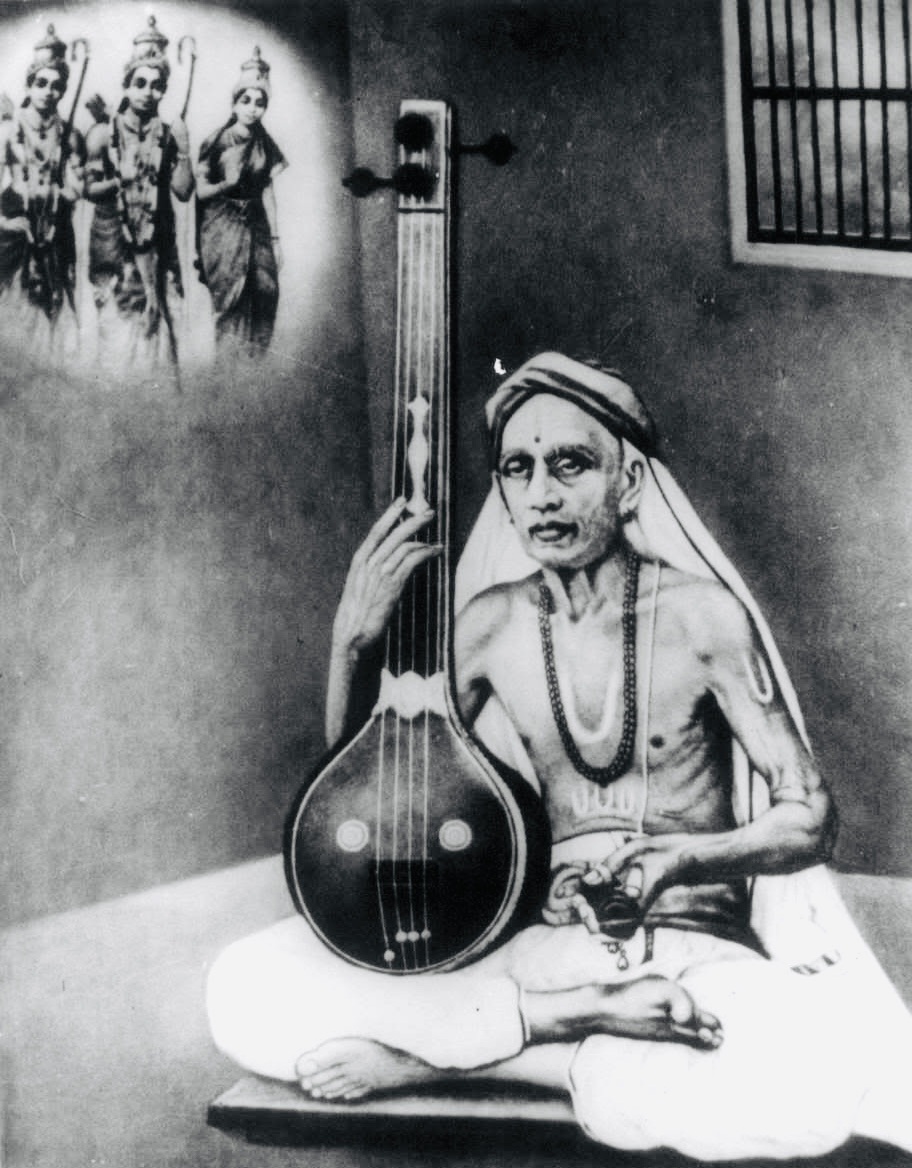
In the long and luminous history of Carnatic music, few names shine as brightly as Tyagaraja. Yet, to call him merely a musical genius would be missing the point.
At heart, Saint Thyagaraja was first and foremost a devotee of Sri Rama.
He was born into a respected family in Thanjavur. His grandfather served as a court poet, and his father was a Vedic scholar who delivered spiritual discourses on the Itihasas. Spirituality and learning flowed naturally through the household.
Perhaps it was destiny that his parents were named Ramabrahman and Sitamma; names echoing the divine couple themselves. For the young Thyagaraja, devotion to Sri Rama was not just practice. It was life itself.
Despite possessing extraordinary musical talent, he chose a path that would puzzle many modern career advisors: simplicity and renunciation.
When family property was divided, Thyagaraja did not ask for land, wealth, or prestige. Instead, he requested only the murtis of Rama and Sita.
In today’s language, you might say he “invested everything” in devotion.
His compositions beautifully carried deep spiritual truths into the homes of ordinary people. Through his kirtans, complex ideas about bhakti, surrender, and the fleeting nature of worldly life became accessible and heartfelt.
Take his famous kriti Mokshamu Galada. In it he asks a powerful question:
“Can moksha truly be attained by someone who has not realised the Self?”
It’s the kind of question that politely rearranges your priorities.
Like many saints, Thyagaraja’s life is sprinkled with moments that feel almost otherworldly.
One day, a wandering sanyasi left a book with him while going to bathe in the river and never returned. That night, the celestial sage Narada appeared in Thyagaraja’s dream and revealed that the book contained his own teachings on swaras and music.
After this, Thyagaraja’s reputation spread widely. Kings invited him to their courts. Students flocked to learn from him.
But he declined royal patronage.
After all, being a court musician might have brought wealth and fame but it would also distract him from his true calling: chanting the Rama Mantra.
Initiated into Rama Nama at a young age, he reportedly repeated it hundreds of thousands of times daily. One night, there was a knock at his door.
When he opened it, he beheld a sight most devotees only dream of.
Sri Rama himself stood there with Ma Sita, Sri Lakshmana, and Hanuman Ji.
After such a darshan, what more could one ask from life?
Even in his compositions, Thyagaraja humbly called himself Ramadasadasa : the servant of the servants of Rama.
As a beautiful aside, the revered sage Chandrashekarendra Saraswati once shared a charming insight in his discourses. He said that when a devotee completes one crore repetitions of the Rama Nama with true bhakti, the tiny bell tied to Shri Rama’s bow rings in the divine realms.
It is as if that sound quietly informs the Lord: “At this place, a devotee has lovingly repeated Your name this many times.” And when such sincere remembrance reaches Him, the Lord cannot remain indifferent.
And then, Sri Rama comes.
Perhaps that explains the life of Thyagaraja perfectly.
In his final days, after accepting sanyasa, Sri Rama appeared to him again and promised that liberation would come within five days. On 6 January 1847, the saint merged into the very Lord he had sung about all his life.
The tradition sums it up beautifully:
“Sri Rama Rama Rameti, Rame Rame Manorame
Sahasranama Tattulyam, Rama Nama Varanane.”
Sometimes a thousand names are powerful.
But sometimes, one name; Rama is enough.
And if stories like this stir something within you, you may enjoy exploring the deeper paths of Mantra, Bhakti, and Tantra with fellow seekers in our quiet circle: https://shorturl.at/6gxgH .
It’s a space where devotion slowly becomes experience one sacred name at a time.
Jai Shri Ram
No responses yet