
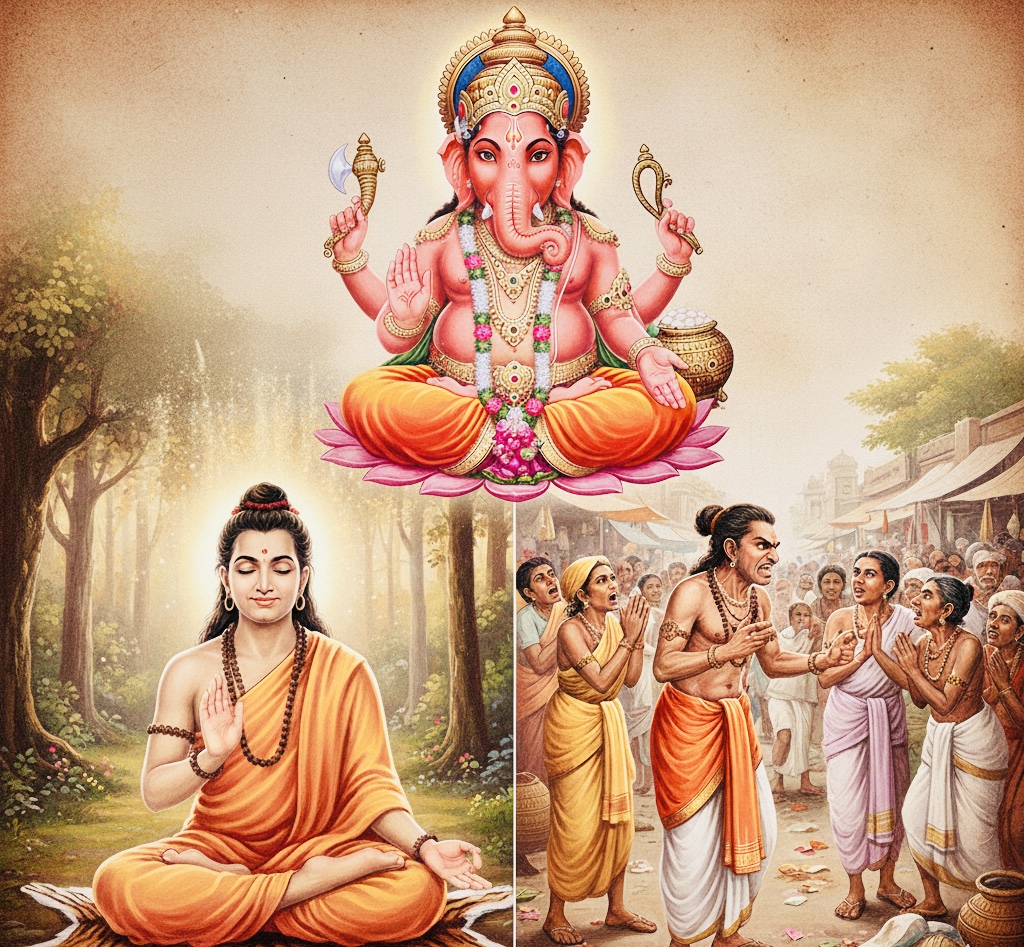
One of the biggest hurdles for beginner sadhakas and quietly, for many experienced ones has nothing to do with mantra counts, initiation, or how long they can sit cross-legged without fidgeting.
It’s this: Their sadhana self never makes it into the rest of their day.
During mantra japa, yoga, or anusthana, everything feels luminous. There is peace. Softness.
A fleeting sense of oneness with the world and goodwill toward all beings.
But the moment the mala is put down and real-life resumes, something strange happens.
The bliss clocks out.
The same person who felt expansive in tantra sadhana ten minutes ago is now gossiping, snapping, competing, envying, scrolling, or subtly stabbing someone in the back sometimes in spiritual spaces themselves. Anyone who has spent time in online dharmic circles has seen this paradox play out.
Jealousy toward a more visible sadhaka.
“Detached” brahmacharis suddenly very attached to the first pleasant face seeking guidance.
All those experiences gained during purascharanas and intense sadhana quietly evaporate because the system hasn’t learned how to digest them.
Why does this happen?
1. Incomplete Spiritual Practice
In traditional Tantra sadhana systems, practice was never just one mantra repeated endlessly. There were supporting deities, supplementary mantras, and inner safeguards designed to address our personal flaws.
For example, in some Shakta traditions, the Aṣṭa Mātṛkās are not merely protectors from external forces; they guard us from ourselves:
• Brahmi dissolves pride
• Maheshvari tempers anger
• Vaishnavi curbs greed
• Varahi confronts envy
• Kaumari clears illusion
Similarly, Ganesh Mantra sadhana is far more nuanced than most modern practice admits.
The Mudgala Purana describes specific forms of Ganapati who subdue inner enemies:
• Vakratunda destroyer of jealousy
• Vighnaraja, dissolver of arrogance
• Vikata, conqueror of lust
Each form has its own Gayatri Mantra, meant to supplement the main moola mantra as the sadhaka matures. These are not optional decorations.
They are psychological and energetic tools. Most people skip them and then wonder why nothing sticks.
2. The “Before and After” Sadhana Trap
Another quiet mistake is dividing the day into sadhana time and everything else. Tantra doesn’t work that way.
When we purify speech, mind, and emotion during mantra practice, that refinement isn’t meant to be switched off at breakfast. The tongue you just sanctified is still the seat of the devata.
What sense does it make to place the deity on a throne and then immediately use that throne for gossip, manipulation, or careless speech?
Sadhana gives you something subtle but powerful: a few seconds of awareness between impulse and action. Catching yourself once is hard. Catching yourself the second time is easier.
Start with small irritations, the “1 to 4” annoyances before tackling the “level-200” people in your life (we all have at least one).
Just as Marcus Aurelius observed long ago-: “We should discipline ourselves in the small things, and from this progress to things of greater value.”
When tantra sadhana begins to walk, speak, and breathe through you without being confined solely to the puja room; it finally does its real work.
If reflections like this resonate, our Tantra circle is a space where practice is grounded, honest, and integrated into real life not polished for performance. You’re welcome to step in, https://shorturl.at/6gxgH observe, and learn how sadhana can slowly become a way of being, not a time slot.
Karuppan Thunai.
No responses yet