
When we speak of dharma in the Mahabharata, we often look for clarity, certainty, and easy moral positions. But dharma, as the Itihasas repeatedly remind us, is rarely comfortable. It demands steadiness more than approval.
No character embodies this unsettling steadiness more than Pitamaha Bhishma.
There is a profound episode recorded in the Srimad Bhagavatam. Sri Krishna is seated quietly, absorbed in thought. Yudhisthira, noticing this, asks Him whom He is contemplating so deeply. Krishna replies simply, “My great devotee.”
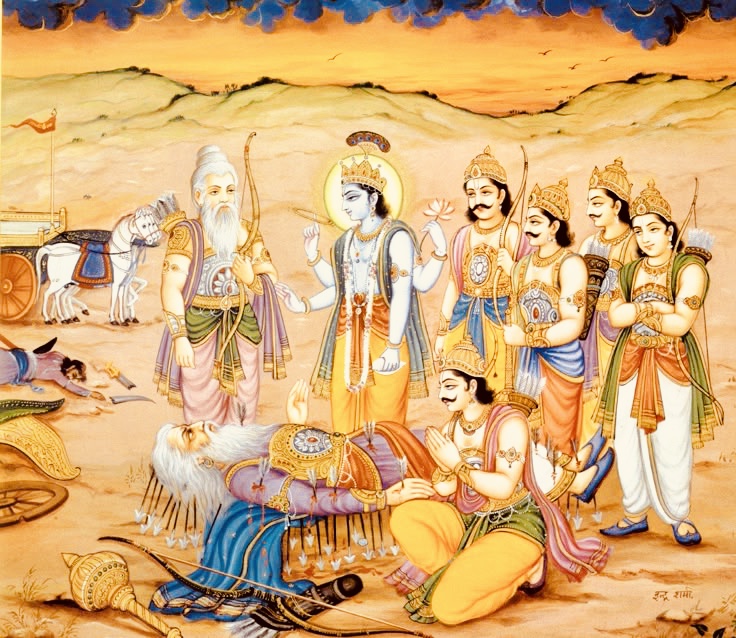
When Yudhisthira asks who this devotee is, Krishna describes a warrior pierced by countless arrows, lying upon a bed of them, yet remaining absorbed in meditation on Him: undisturbed even by intense physical suffering.
That devotee is Bhishma.
This moment, which serves as a precursor to the Bhishma Stuti in the Bhagavata Purana, tells us immediately how dear Bhishmacharya was to Sri Krishna. And yet, paradoxically, Bhishma has become one of the most criticised figures in modern retellings of the Mahabharata.
Once revered as Devavrata, Bhishma is now often reduced to a convenient symbol; used to critique patriarchy, social injustice, or perceived moral failures within Hindu society.
While contemporary interpretations can sometimes open new perspectives, problems arise when they dismiss or contradict what the original texts themselves state.
This reflection is not meant as a polemical rebuttal. Instead, it chooses a simpler and more traditional approach: to listen to how Bhishma is described by Vyasa, Devarishi Narada, Yama Dharmaraja, and Sri Krishna Himself.
A common issue in modern readings of ancient texts is attribution bias: the tendency to assign motives to actions without any direct textual support. We see this often in everyday life, where we assume intentions based on personal preference or dislike.
When applied to sacred texts, this habit becomes even more problematic.
For instance, speculative interpretations of Sita Devi’s Agni Pariksha frequently ignore what the Ramayana itself explains, preferring modern assumptions over scriptural context and traditional commentaries. A similar approach is taken with Bhishma where imagined motives replace textual evidence.
Closely related is the lowest common denominator approach, where a complex, multi-layered personality is flattened into a simple moral lesson. While such simplification may serve modern narratives, it strips the tradition of its depth and subtlety.
Now consider how Bhishma is remembered within the texts themselves.
There is an old understanding in our tradition:
A person’s life is revealed by who stands beside them at the time of death.
When Bhishma lay on his bed of arrows, waiting for his chosen moment to depart, who surrounded him? Devarishi Narada. Brahmarishi Vasishta. Veda Vyasa. Bharadwaja Muni. The Saptarishis. And seated beside him until the very end was Sri Krishna Himself.
This scene, described in the Bhagavata Purana (Canto 1, Chapter 9), is extraordinary. Such grace is not easily attained even by great realised beings.
Would the Supreme Lord remain personally present for someone who had misunderstood dharma or failed as a devotee?
Our scriptures repeatedly affirm that Bhagavan may tolerate offences directed toward Himself, but not those aimed at His true devotees. Saiva texts declare that serving a Shiva-bhakta is equal to serving Shiva.
The Narada Bhakti Sutras go even further, stating that there is ultimately no difference between the Lord and His exalted devotees. Conversely, speaking ill of such devotees is said to generate serious spiritual consequences.
So what kind of devotee was Bhishma?
Devarishi Narada answers this directly. In the Narada Bhakti Sutras, he names four peerless exemplars of bhakti placing Bhishma first, followed by Prahlada, Uddhava, and finally himself.
Yama Dharmaraja, while instructing his attendants in the Srimad Bhagavatam (Canto 6), lists twelve Mahajanas, the great authorities on dharma:
svayambhur naradah sambhuh
kumarah kapilo manuh
prahlado janako bhismo
balir vaiyasakir vayam
This list includes Brahma, Narada, Shiva, the Kumaras, Kapila Muni, Manu, Prahlada, Janaka, Bhishma, Bali, Sukadeva, and Yama himself.
There is also a well-known verse stating that remembrance of six great Vishnu-bhaktas Bali, Vibhishana, Bhishma, Prahlada, Narada, and Dhruva destroys sin-
baliḥ vibhīṣaṇo bhīṣmaḥ prahlādo nārado dhruvaḥ .
ṣaḍete vaiṣṇavāḥ proktā smaraṇaṃ pāpanāśanam .
Given such exalted status, many struggle with certain events in Bhishma’s life. Why did he fight on the side opposed to Sri Krishna? Why did he remain silent during Draupadi’s disrobing?
As traditional acharyas have pointed out, Bhishma, being a Mahajana, cannot be accused of ignorance or moral failure. Apparent contradictions in the lives of pure devotees are not mistakes;
They serve as instructions for conditioned souls and enhance the divine play of the Lord.
Even Bhishma’s arrows aimed at Sri Krishna were an expression of devotion veera rasa, the chivalrous mood of bhakti. Bhishma himself declares in the Bhishma Stuti that he took a vow to make Krishna break His own oath of not taking up weapons. Out of love for His devotee, Krishna fulfilled that vow.
Common criticisms regarding Bhishma’s vow of celibacy, his engagement in battle against his guru, or the abduction of Amba often dissolve when examined through shastric context. Dharma is subtle. Exceptions exist.
Social norms of a different yuga cannot be judged wholesale using modern ethical frameworks especially when similar actions by other revered figures are selectively ignored.
When Bhishmacharya is understood as Vyasa, Narada, Yama, and Krishna present him; a peerless bhakta and Mahajana; many modern accusations lose their force.
Perhaps the greater contradiction lies elsewhere.
Many take ritual dips in the Ganga, praying for the cleansing of their paapa, while simultaneously harbouring contempt for her son the Ganga Putra, Bhishma.
That irony alone is worth contemplating.
If reflections like these invite you to approach our traditions with more patience, humility, and depth, you may find value in continuing this exploration with fellow seekers.
Our Tantra circle: https://shorturl.at/6gxgH is a space where scripture is engaged seriously but gently, where devotion deepens into lived understanding rather than quick judgement.
You are welcome to step in when the calling feels sincere.
No responses yet